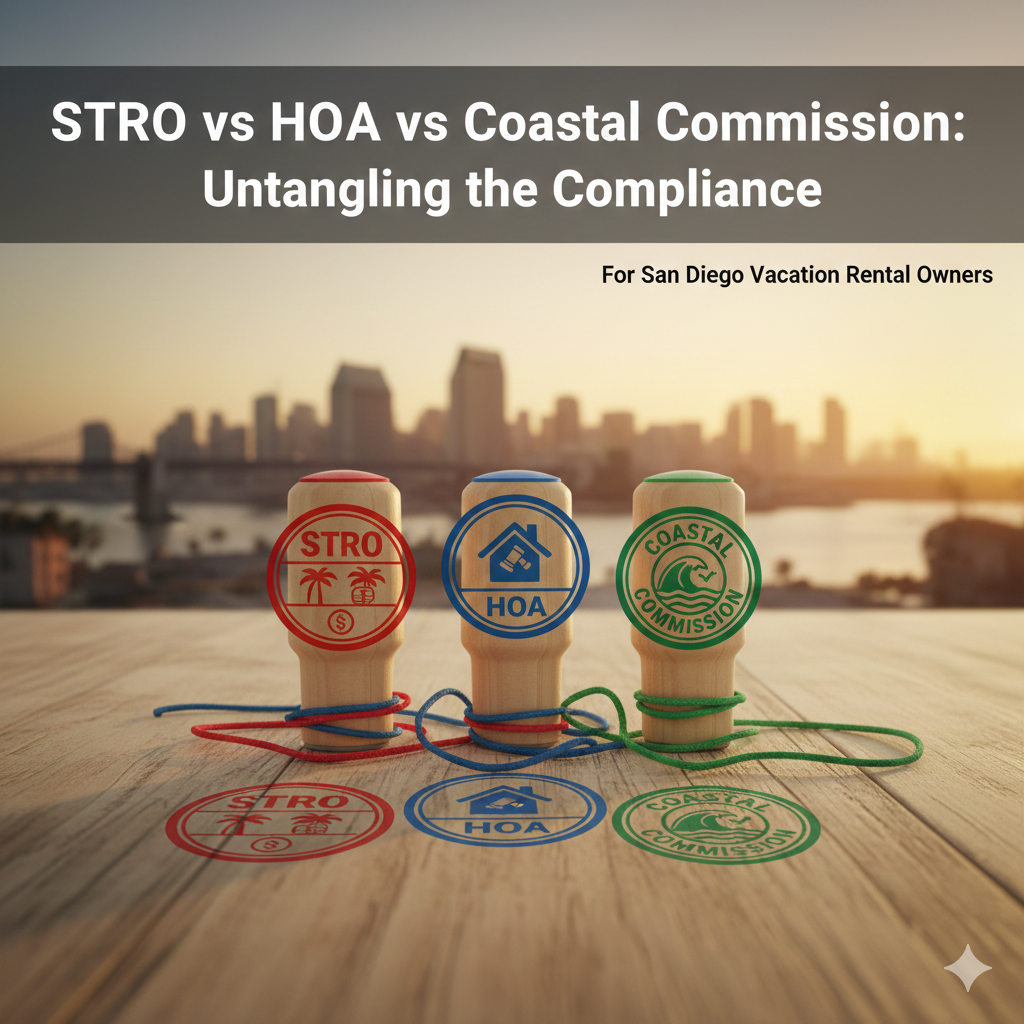
STRO vs. HOA vs. Coastal Commission: Untangling the Compliance Maze in San Diego
We often speak with San Diego vacation rental owners who are surprised to learn that getting city approval under the Short-Term Residential Occupancy (STRO) Ordinance isn’t the final word on legality. In fact, San Diego’s regulatory landscape is a three-way tug-of-war between the the city of San Diego’s STRO program, California Coastal Commission oversight, and HOA or CC&R restrictions. These layers can overlap, contradict, or leave costly gaps in understanding.
This guide breaks down each regulatory body’s role, highlights real-world conflicts, and gives you a practical strategy for staying compliant across the board.
| Regulation | Governing Body | Applies to | Key Power |
|---|---|---|---|
| STRO Ordinance | City of San Diego |
All short-term rentals (under 30 days) |
Issues licenses, enforces zoning restrictions |
| California Coastal Act |
California Coastal Commission All short-term rentals (under 30 days) |
Properties in the Coastal Overlay Zone |
Requires coastal permits for changes in visitor-serving use |
| HOA CC&R’s |
Homeowners Associations |
Properties in managed communities |
Can prohibit or restrict short-term rentals outright |
STRO Ordinance (City of San Diego)
What it does:
Since 2023, San Diego requires all vacation rental operators to register under one of four STRO license tiers. These licenses regulate how often you can rent, whether you must live on-site, and how many rentals are allowed in your neighborhood.
Key compliance rules:
- Licenses required for all stays under 30 days
- Tier 3 and 4 licenses (whole-home rentals) are capped by lottery
- Only one license per person in the city (with few exceptions)
- Enforcement includes fines and license revocation for violations
What it doesn’t do:
The STRO license doesn’t override Coastal Commission oversight or HOA rules.
California Coastal Commission (CCC)
What it does:
If your property is in San Diego’s Coastal Overlay Zone (basically everything west of I-5), the CCC can require Coastal Development Permits (CDPs) for changes in land use that affect public coastal access.
Fun twist: The CCC often views short-term rentals as visitor-serving, which is typically encouraged in coastal law, but only if they don’t reduce long-term housing or public beach access. In recent years though the Coastal Commission has taken actions which inhibit affordable access to the beach in an effort to creat more long term housing.
HOA & CC&Rs (Restrictions)
What they do:
HOAs and condominium communities often have Covenants, Conditions, and Restrictions (CC&Rs) that either ban or limit short-term rentals. These restrictions are private contracts enforceable by civil law, even if you have a valid STRO license.
Common HOA restrictions include:
- Minimum rental periods (30+ days)
- Caps on total STRs in the community
- Requiring HOA board approval for rentals
- Prohibiting all short-term rentals entirely
Real-world conflict:
A Mission Beach owner received a Tier 4 whole-home license from the city but was later fined by their HOA, which had a 30-day rental minimum. Despite city approval, they were forced to remove the listing or face legal action.
How to Stay Compliant on All Fronts
- Start with your HOA (if applicable):
Check your CC&Rs for rental restrictions before applying for any STRO license. HOA restrictions supersede city permissions in civil court. - Apply for the correct STRO license:
Follow city guidelines and don’t assume getting a license clears you everywhere. The city will not vet your HOA or CCC compliance. - Consult a local land use attorney or STR expert if you’re unsure:
Especially in high-conflict areas like La Jolla, Mission Beach, or Point Loma, overlapping rules can lead to lawsuits, permit revocations, or enforcement actions.
Bonus Tip: Don’t Blindly Trust the Platforms
Airbnb and VRBO may let you list a property – even if it violates HOA rules or Coastal permit requirements. You’re still on the hook for compliance.
Final Thoughts
Getting legal to operate a short-term rental in San Diego isn’t just about city paperwork. It’s about navigating a triple-layer cake of regulation, municipal, coastal, and private. By understanding each layer and how they interact, you can protect your investment, avoid fines, and build a more sustainable rental business.
Need help navigating your property’s compliance?
Farawae Vacation Rentals offers STRO compliance audits, permit application guidance, and HOA-consulting for hands-off investors and second-home owners.







Leave A Comment